


Canada’s preliminary 2024 suicide mortality rates were 2.2 deaths per 100,000 people aged 10–14 and 7.7 per 100,000 aged 15–19. Those rates come from the Public Health Agency of Canada (PHAC). The 15–19 group includes young adults aged 18 and 19. These are population death rates, not the percentage of teenagers who die by suicide.
A separate PHAC survey found that 8.4% of youth aged 12–17 reported serious suicidal thoughts during the previous year in 2023, while 2.0% reported a suicide attempt. The ten-province survey excluded the territories. Thoughts, attempts, deliberate self-harm and deaths are different outcomes. They cannot be added into a single youth suicide rate.
Newer CAMH 2025 Ontario student findings offer a separate view of student wellbeing. This report explains what each statistic measures, adds transparent comparisons and identifies where a 2026 peer-reviewed study found different long-term mortality patterns by age and sex. The data cannot assess an individual young person’s safety.
If someone is in immediate danger, call 9-1-1. In Canada, call or text 9-8-8 for suicide-related support, including concern about someone else. Young people can also reach Kids Help Phone by texting CONNECT to 686868.
Canadian youth suicide and self-harm: dated statistics
| Measure | Reported value | Original source |
|---|---|---|
| Youth ages 12–17 reporting serious suicidal thoughts (2023; ten provinces) | 8.4% | PHAC / CHSCY (2023) |
| Suicide mortality at ages 10–14 (2024, preliminary) | 2.2 per 100,000 | PHAC (2024) |
| Suicide mortality at ages 15–19 (2024, preliminary) | 7.7 per 100,000 | PHAC (2024) |
| Youth ages 12–17 reporting suicide attempts (2023; ten provinces) | 2.0% | PHAC / CHSCY (2023) |
| Ontario students reporting self-harm (2025) | 15% | CAMH / OSDUHS (2025) |
| Ontario students reporting serious suicidal thoughts (2025) | 16% | CAMH / OSDUHS (2025) |
| Ontario students reporting a suicide attempt (2025) | 4% | CAMH / OSDUHS (2025) |
Youth suicide statistics in Canada: key findings
PHAC’s official surveillance provides population death rates for 2024, while its national youth survey covers suicidal thoughts and attempts in 2023. Ontario’s OSDUHS provides a separate classroom-survey comparison through 2025.
The most important reading rule is to keep the denominator beside the number. Mortality figures are deaths per 100,000 residents of a given age. Survey estimates are percentages of respondents represented by their sampling design. Hospitalizations measure hospital care episodes.
The key-figures table above summarizes the findings. Detailed tables, download links and methodology follow. No statistics on this page are a substitute for a professional assessment of a child who needs help.
What is the suicide death rate for Canadian youth?
PHAC’s most recent mortality presentation includes preliminary 2024 age-specific suicide death rates. The rate was 2.2 deaths per 100,000 people aged 10–14 and 7.7 per 100,000 aged 15–19.
The older age group’s reported rate was 3.5 times the younger group’s rate. This calculation divides 7.7 by 2.2. It is a comparison of population rates, not an individual probability. Importantly, the 15–19 group includes young adults aged 18 and 19.
| Age group | Boys/men | Girls/women | Both sexes |
|---|---|---|---|
| 10–14 | 1.6 | 2.8 | 2.2 |
| 15–19 | 8.9 | 6.3 | 7.7 |
Deaths per 100,000 people; calendar year 2024. Source: PHAC suicide mortality, preliminary age-specific rates, subject to revision.


A different age pattern is visible by sex. The provisional rate for girls aged 10–14 was 2.8, versus 1.6 for boys. At ages 15–19, the male rate was 8.9 versus 6.3 for females. Small population counts and preliminary reporting warrant care when interpreting either difference.
Across all ages, PHAC recorded 4,394 deaths by suicide in 2024. That total is not a count of teen deaths. PHAC warns that investigations take time, meaning later releases can revise preliminary deaths upward.
Are youth suicide rates rising or falling in Canada?
The answer depends on the age group, sex and years studied. A 2026 peer-reviewed analysis by Zulyniak and colleagues examined Canadian suicide mortality between 2000 and 2024, using joinpoint regression to identify periods of significant change. This is a published study’s analysis, not a new model developed by Discreet Investigations.
| Cohort | Period examined by the researchers | Reported annual percent change | Interpretation |
|---|---|---|---|
| Males aged 15–19 | 2018–2024 | −8.37% | Mortality rate declined during this study-defined segment |
| Females aged 10–14 | 2000–2024 | +2.40% | Mortality rate increased across the longer study interval |
Source: Zulyniak et al., Canadian Journal of Psychiatry, published September 3, 2026. The percentage values are the study authors’ modeled annual percent changes (APCs), not observed year-to-year changes or percentage-point changes in population share.
The authors reported statistical significance for those segments. They also found a decline in the overall Canadian suicide mortality rate during 2018–2024. That overall result does not erase differences between age and sex groups.
The peer-reviewed study and PHAC’s preliminary 2024 surveillance do not use an interchangeable, single-vintage 2024 series. Their exact 2024 age/sex rates may differ because of reporting and analytical sources. This article does not splice the study’s historical endpoints onto PHAC’s preliminary rates or manufacture missing annual observations.
In the 2025 CAMH student survey, serious suicidal thoughts increased from 11% in 2001 to 16% in 2025. That is a separate self-reported outcome, not evidence of a change in suicide deaths. The Ontario survey found recent stability despite the longer historical increase.
Small annual counts in younger age groups can make rates less stable. None of these population trends predicts what will happen to an individual young person.
Suicidal thoughts and attempts among Canadian teenagers
PHAC’s Suicide Surveillance Indicator Framework reports that 8.4% of Canadian youth aged 12–17 had serious suicidal thoughts in the previous 12 months in the 2023 Canadian Health Survey on Children and Youth (CHSCY). The survey included the ten provinces and excluded the territories.
The same PHAC tool publishes separate attempt measures for that age group: 2.0% reported an attempt in the previous year, and 4.6% reported ever attempting suicide. These questions have different timeframes. The percentages describe respondent-reported experiences, not a register of patients or clinically diagnosed conditions.
| 2023 CHSCY measure | Youth ages 12–17 | Time period |
|---|---|---|
| Serious suicidal thoughts | 8.4% | Previous 12 months |
| Reported suicide attempt | 2.0% | Previous 12 months |
| Ever reported a suicide attempt | 4.6% | Lifetime through time of survey |
Source: PHAC, Suicide Surveillance Indicator Framework data tool, CHSCY 2023; ten provinces.
The age-specific results for the serious-thoughts measure show 5.8% at ages 12–14 and 11.4% at ages 15–17, a 5.6-percentage-point difference based on rounded estimates. The reported difference in the survey should not be interpreted as an individual’s risk doubling when they reach 15.
| Age group, 2023 | Girls | Boys | Both sexes |
|---|---|---|---|
| Ages 12–14 | 9.3% | 2.6% | 5.8% |
| Ages 15–17 | 14.5% | 8.3% | 11.4% |
Source: PHAC, suicidal ideation surveillance. Source labels for girls and boys retained; results are self-reported.
In the younger group, the displayed girls-minus-boys difference is 6.7 percentage points. For ages 15–17, it is 6.2 points. These are descriptive differences from rounded survey estimates; no significance test was performed here. The mortality rates described above show different patterns and measure deaths, not thoughts or attempts.
Self-harm and suicide attempts among Ontario students
CAMH’s 2025 Ontario Student Drug Use and Health Survey (OSDUHS) included 11,108 students in grades 7–12 attending 246 Ontario schools. Data came from anonymous questionnaires administered between December 2024 and June 2025. The survey represents school students, not every young person residing in Ontario.
| Measure, past year | 2023 | 2025 | Arithmetic difference |
|---|---|---|---|
| Deliberate self-harm | 19% | 15% | −4 percentage points |
| Serious suicidal thoughts | 17.7% | 15.7% | −2.0 percentage points |
| Reported suicide attempt | 4.7% | 3.9% | −0.8 percentage points |
Sources: CAMH 2025 OSDUHS summary, page v and appendix table; CAMH 2023 OSDUHS report, page 61. Self-harm is reported as whole-percent rounded figures; the other two values are reported to one decimal place. Differences use the displayed values.

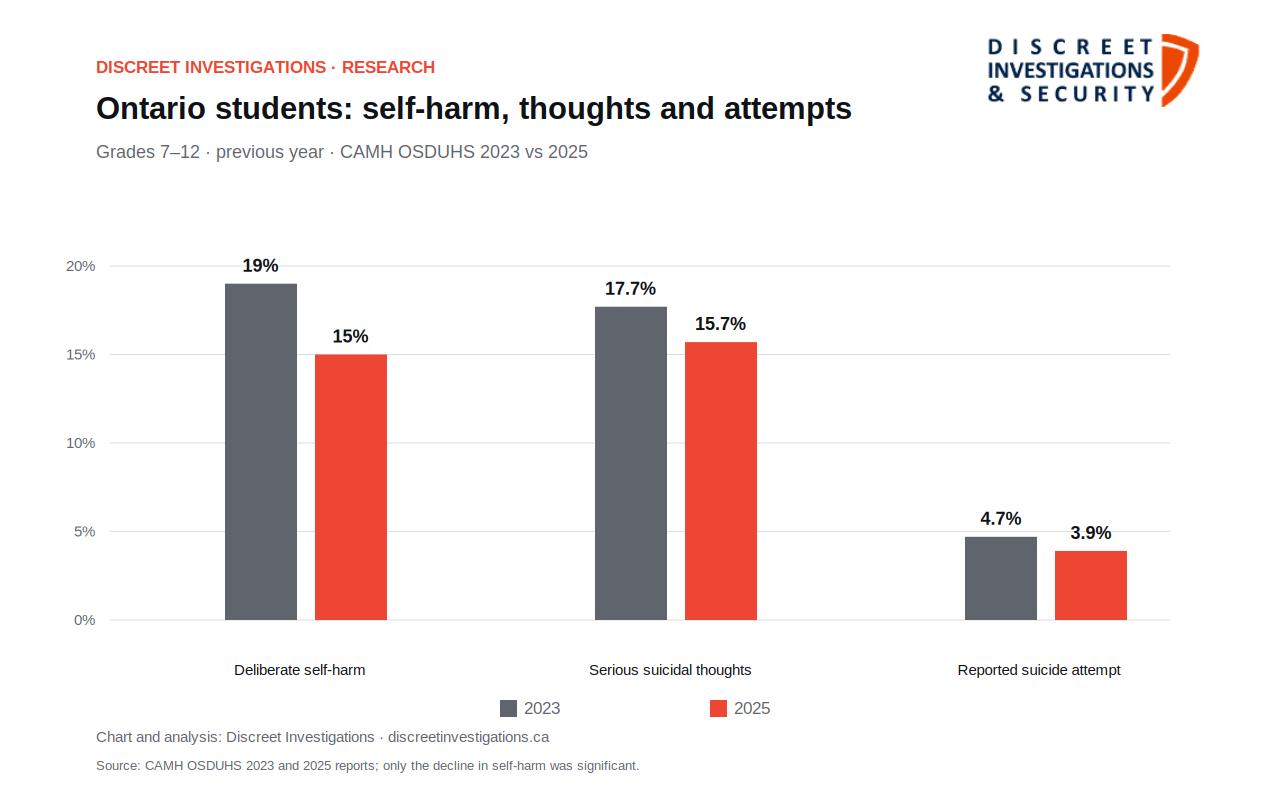
CAMH identified the decline in self-harm from 19% to 15% as statistically significant. It described serious suicidal thoughts as stable in recent years, and suicide attempts as fluctuating within a narrow range since monitoring began in 2007. The displayed −2.0- and −0.8-point differences should not be called statistically significant improvements.
The longer trend in serious suicidal thoughts also deserves attention: 11% in 2001 versus 16% in 2025. That comparison describes an Ontario school survey over time and is not a Canadian suicide mortality trend.
Self-harm hospitalizations in Canada
The Public Health Agency of Canada’s hospitalization surveillance finds the highest self-harm hospitalization rates among those aged 15–19, with girls hospitalized at roughly four times the rate of boys. In the 10–14 group, PHAC describes an approximately eightfold girls-to-boys difference. Those ratios are the agency’s rounded descriptions, not independently estimated exact ratios.
PHAC also reports that its hospitalization rates exclude Quebec. The CIHI hospitalization indicator uses episodes of inpatient care, not counts of unique people. It captures intentional self-harm whether or not there was intent to die, and it omits many incidents never admitted to hospital.
The broader PHAC data tool lists a 2024/2025 all-ages rate of 54 hospitalizations per 100,000, but that number is not a youth-specific rate. It is intentionally excluded from the youth comparison and charts. CIHI provides an age-filtered download interface, but I did not independently extract and reconcile the full youth rates from that interface for this edition.
Hospitalizations cannot be added to school-survey attempts or suicide deaths to construct a single total. Doing so would mix people, episodes, ages, years and geographic coverage.
What do suicide, self-harm and ideation statistics measure?
Five different measures appear in Canadian suicide surveillance. They answer different questions and have different sources.
| Measure | Meaning | Common data source |
|---|---|---|
| Suicidal thoughts, or ideation | A respondent reports thoughts about suicide over a specified period | Population or school survey |
| Suicide attempt | A respondent reports an attempt to end their life | Population or school survey |
| Deliberate self-harm | Intentional self-injury, which can occur with or without suicidal intent | Survey, emergency department or hospital data |
| Self-harm hospitalization | An episode of inpatient care recorded as intentional self-harm | Hospital discharge records |
| Suicide mortality | A death classified as suicide by death investigators | Coroner or medical examiner records |
It would be incorrect to add any of these figures together. A person can appear in more than one category. A hospitalization series records episodes rather than unique people. Death rates use population denominators, while survey prevalence uses the number of people represented by a survey.
The Canadian Institute for Health Information (CIHI) emphasizes that self-harm admissions include both suicidal and non-suicidal events. They omit injuries coded as accidental or undetermined, so the published indicator is an incomplete measure of all self-harm.
How national and Ontario youth data differ
A direct comparison of PHAC’s national 8.4% and CAMH’s Ontario 15.7% suicidal-thoughts estimates would be invalid. The PHAC estimate is from 2023 and covers ages 12–17 across ten provinces. CAMH’s estimate is from its 2025 Ontario grades 7–12 school survey. The populations, years, sampling and question formulations differ.
PHAC’s 2.0% previous-year attempt estimate and CAMH’s approximately 3.9% in 2025 likewise do not measure a consistent national-versus-provincial difference.
Use the same metric, source, sample definition and survey programme when describing a trend. The 2023 and 2025 CAMH percentages are comparable published cycles of the same Ontario survey, though only the self-harm change was identified as significant by CAMH.
For other context on families, see the site’s missing-children statistics in Canada and online harassment statistics. These police and victimization figures answer entirely different questions; neither establishes the causes of youth suicidal behaviour.
What can parents take from the research?
The figures describe groups, not individual predictions. A teen can need urgent help regardless of demographic averages or whether a school survey showed improvement in a recent cycle. This report cannot diagnose a child or determine safety.
The Government of Canada’s prevention guidance recommends compassionate, direct conversation and help from trained professionals. Asking someone directly about suicidal thoughts does not create suicidal thoughts.
CAMH reported in 2025 that 29% of Ontario students felt they needed mental-health support in the previous year but did not seek it. Among the survey’s reported barriers were concerns about family finding out and whether professional help would work. These are student reports, not proof of the reasons for any particular person’s actions.
Separate family-safety material on this website includes a case study about an unsafe home environment and guidance for parents of a missing or runaway child. Neither is suicide-prevention guidance. When a young person is in danger, prioritize emergency and qualified clinical support.
Data downloads, research provenance and limitations
Readers can browse the wider Discreet Investigations research library for separate studies of missing persons, family safety and related statistical topics. This report concerns health statistics and does not offer clinical assessment or crisis intervention.
This is a secondary analysis of published aggregate statistics. The underlying survey responses, vital records and hospital records were collected and analyzed by their originating organizations. Discreet Investigations did not conduct the original studies, model mortality trends or clinically evaluate participants.
Download the combined attributed indicator table (CSV). Each row gives its source, age group, geography, time period and unit, so incompatible outcomes cannot be silently pooled. The same evidence is available in narrower extracts: 2024 mortality, 2023 suicidal thoughts, 2023 youth attempts, and 2023–2025 Ontario students. Source URLs in each extract allow independent checks.
What was calculated here: differences between published survey percentages were computed as arithmetic percentage points. The 2024 PHAC age-group mortality rate ratio is 7.7 ÷ 2.2 = 3.5, computed from rounded displayed rates. Differences between age groups and survey sex categories were also calculated from official published point estimates. No confidence intervals, survey weights or new nationally pooled values were calculated. The modeled mortality APCs are credited to the peer-reviewed authors.
Limitations that matter:
- The 2024 PHAC mortality rates are preliminary and subject to revision.
- PHAC ages 15–19 include 18- and 19-year-olds. CHSCY ages 12–17 and CAMH grades 7–12 are different populations.
- The CHSCY 2023 survey excluded Canada’s territories. CAMH’s OSDUHS covers Ontario students.
- PHAC’s hospitalization page excludes Quebec; admissions reflect episodes, not unique people.
- The 2023 CAMH ideation and attempt estimates were checked against its original 2023 report. The 2025 estimates use its 2025 summary appendix.
- Mortality, reported attempts, suicidal thoughts, self-harm and psychiatric distress must remain separate measurements.
- The 2026 mortality trend study uses its own statistical model and may differ from PHAC’s preliminary 2024 surveillance vintage.
- Statistical association is not proof that bullying, family conflict, social media or another factor caused a specific death or attempt.
Attribution and update policy: PHAC, CAMH and CIHI are credited as the primary data owners. The 2026 study is credited for its modeled results. All calculations and tables are independently reproducible from cited displayed values; no authorship or endorsement by these institutions is implied. Future updates should check the original sources for revisions and add them only if denominators and vintages remain identifiable.
Support for young people and parents in Canada
For immediate danger, call 9-1-1. For suicide-related concerns, people in Canada can call or text 9-8-8. The 9-8-8 Suicide Crisis Helpline offers support day and night, including to those concerned about another person.
Kids Help Phone supports children and young people. Call 1-800-668-6868 or text CONNECT to 686868. Parents and caregivers can also contact a doctor, licensed mental-health professional or local youth mental-health service.
Research note: This page is public statistical information, not medical advice or a way to assess an individual child’s safety. A private investigation is not an alternative to qualified crisis care.
Frequently asked questions
What is the suicide death rate for youth in Canada?
Are youth suicide rates increasing or decreasing in Canada?
What percentage of Canadian teenagers report suicidal thoughts or attempts?
How common is self-harm among Ontario students?
Is a self-harm hospitalization the same as a suicide attempt?
Where can parents or young people in Canada get immediate help?
Sources
- PHAC: Suicide mortality in Canada, age and sex rates (2024, preliminary)
- PHAC: Suicidal ideation among Canadian youth, CHSCY 2023
- CAMH: 2025 OSDUHS Mental Health and Well-Being Summary Report
- CAMH: August 24, 2026 OSDUHS release
- PHAC: Self-harm hospitalizations
- CIHI: Self-Harm Hospitalizations indicator definition
- Government of Canada: Preventing suicide, when and how to help
- 9-8-8 Suicide Crisis Helpline: Get help now
- Kids Help Phone
- PHAC: Suicide Surveillance Indicator Framework data tool, youth ideation and attempts (2023)
- CAMH: 2023 Ontario Student Drug Use and Mental Health Survey trend report, suicidal ideation and attempts
- Zulyniak and colleagues: Canadian suicide mortality trends, 2000–2024 (Canadian Journal of Psychiatry, September 2026)